
The Letter
On the sacred, endangered art of actually reaching someone

Simone came in from the mailbox, arms full of the usual assortment of envelopes that no one actually wants. A bill. A flyer. Something from someone trying to sell us something we did not ask for. The stack landed on the counter and I barely looked up.
But then she held one out toward me. Small. White. Handwritten.
I recognized the name in the return address before I even touched it.
I opened it slowly, the way you open something when you are excited and curious and intrigued and said, “well what is this”. Inside was a short letter, maybe half a page, written by a friend who had clearly sat with something before putting pen to paper. He was not responding to anything I had said. He was not following up on a conversation. He had simply, at some point in his own life, stopped. Thought of me. Prayed, I believe. And then wrote it down, sealed it, stamped it, and mailed it.
It was encouraging. It was full of faith. It felt, in a way I am still sitting with, like being seen.
Not tagged. Not mentioned. Not liked or replied to. Seen.
I stood at the counter for a long moment after I finished reading it.
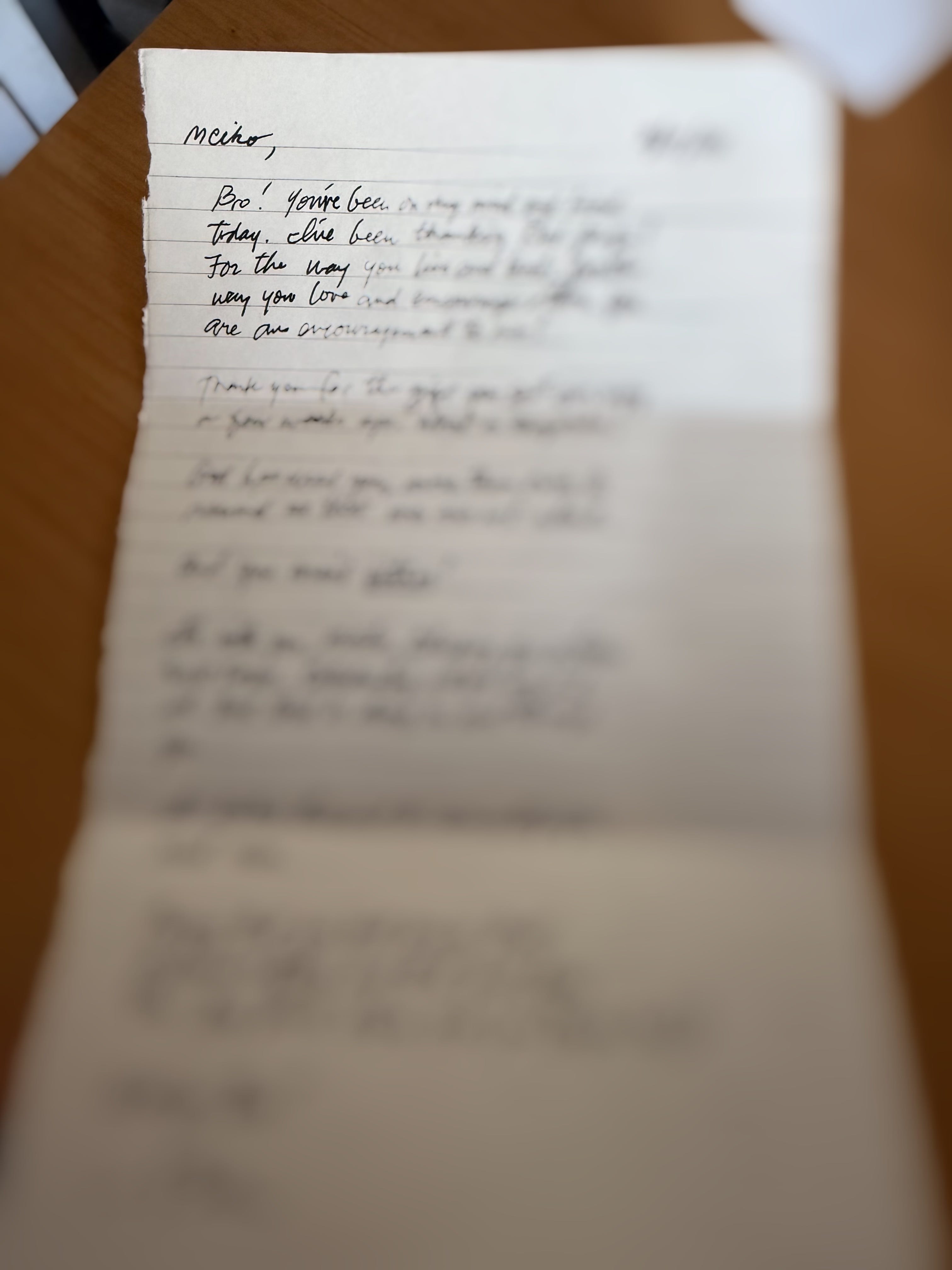
We have made it very easy to acknowledge each other and very difficult to actually reach each other.
There is a version of connection that costs almost nothing. A reaction, a comment, a quick voice note sent at a red light. I am not saying these things have no value. I am saying they have conditioned us to believe that fast is the same as real. That volume is the same as depth. That being in someone’s mentions is the same as being present in their life.
It is not.
The letter my friend wrote took time. It required him to go somewhere inside himself, to listen for something before he spoke it, to trust that what he felt toward me was worth the small and deliberate act of writing it down and sending it into the world. He had to buy a stamp. Do you know how few of us buy stamps anymore?
There is something holy about the slow things. There always has been. The desert fathers and mothers knew it. The monastic tradition built a whole way of life around it. The idea that formation happens in the unhurried, that presence is not efficient, that love often looks like sitting still when everything in us wants to move.
I think we are losing this. I think we are becoming people who are connected to everyone and present with almost no one. And I think it is costing us something we cannot yet fully name.
Here are three invitations. Not programs. Not productivity hacks. Just three ways to practice the slower, older, more human art of actually reaching someone.
Write the letter.
Not the text. Not the DM. The letter. Pick up a pen and write to someone who has been on your mind, someone you have been meaning to check on, someone you love but have been meaning to say so for longer than you want to admit. You do not have to be eloquent. You do not have to be long. You just have to mean it. There is something that happens in the act of handwriting that does not happen anywhere else. The pace forces you to be intentional. The paper holds it in a way a screen cannot. And the person on the other end will feel the weight of the thing you took the time to send.
Make the call you keep putting off.
Not a voice memo. A call. A real-time, two-way, no-editing conversation. We have grown accustomed to the asynchronous, to answering in our own time and on our own terms. But there is something irreplaceable about being live with someone, about the laugh that comes before the joke is finished, about the silence that says more than anything either of you would have typed. Think of the person. Make the call. Let it be a little awkward at first. Stay on anyway.
Show up in person with no agenda.
This one costs the most and gives back the most. Drive over. Knock on the door. Bring something small, coffee, food, something from a place you know they love. Do not need anything from them. Do not have a point to make. Just be there, in the room, in the same air, taking up space together in a way that the digital world simply cannot replicate. We were not designed for disembodied community. We were made to be near each other. Presence is a form of theology.
My friend probably had no idea what that letter would mean to me. He was probably just being faithful to a quiet prompting that said, write it, and so he did.
That is the thing about the slow, the deliberate, the unhurried. It tends to arrive exactly when it is needed. It tends to find people in ways the fast things cannot.
I am going to write him back. By hand. On paper.
I need to go by the stamp.
Meeks